Understanding the Core Purpose of Traffic Guardrails
Traffic guardrails are a common feature along highways, bridges, urban roads, and rural routes. Their presence is often taken for granted, yet their purpose involves a balance of multiple safety considerations. Rather than serving a single protective role, guardrails are designed to manage the interaction between vehicles, pedestrians, and surrounding road infrastructure. Understanding who or what is primarily protected requires examining how guardrails function during normal traffic conditions and during collision events.
Vehicle Occupants as a Primary Safety Consideration
One of the central design motivations behind traffic guardrails is the protection of vehicle occupants. When a vehicle leaves its intended travel path due to driver error, weather conditions, or mechanical failure, the consequences can be severe. Guardrails are positioned to redirect or decelerate vehicles in a controlled manner, reducing the risk of rollover, collision with rigid obstacles, or entry into hazardous zones such as steep slopes, bodies of water, or opposing traffic lanes.
By absorbing kinetic energy and guiding the vehicle back toward the roadway or along the barrier, guardrails aim to reduce the forces transmitted to passengers. This function is especially important on high-speed roads, where uncontrolled departures from the roadway can lead to life-threatening outcomes.
Pedestrian Safety and Indirect Protection
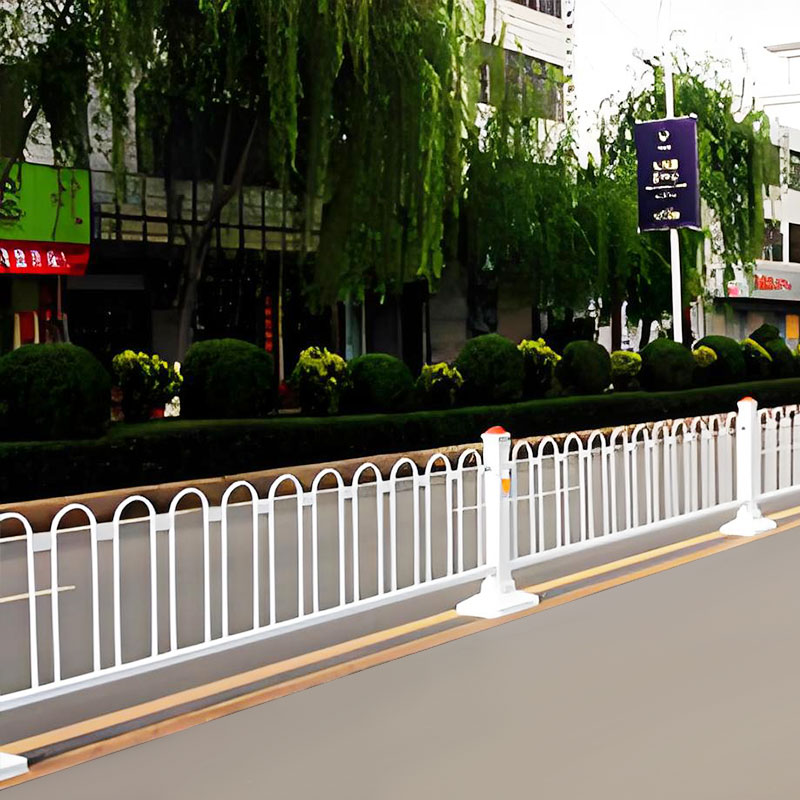
While traffic guardrails are not primarily designed as pedestrian barriers, they play an indirect role in pedestrian safety. In urban environments, guardrails often separate vehicle lanes from sidewalks, crossings, or cycling paths. This separation helps prevent vehicles from entering pedestrian spaces, especially in areas with heavy traffic flow or complex intersections.
In these contexts, guardrails act as a buffer zone. They reduce the likelihood of vehicles mounting curbs or striking roadside users. However, their height, spacing, and structural characteristics are generally optimized for vehicle interaction rather than pedestrian containment, which distinguishes them from fences or crowd-control barriers.
Protection of Road Infrastructure
Road infrastructure includes bridges, tunnels, lighting poles, signage supports, drainage systems, and embankments. Many of these elements are costly to repair and may pose additional hazards if struck by vehicles. Guardrails are frequently installed to shield such structures from direct impact, preserving their integrity and functionality.
For example, on bridges, guardrails prevent vehicles from colliding with structural components or falling off elevated surfaces. Along highways, they may protect retaining walls or slopes that could collapse or erode if repeatedly impacted. In this sense, guardrails serve an economic and structural preservation role alongside safety objectives.
Balancing Multiple Protective Targets
Rather than prioritizing one protective target exclusively, traffic guardrails are designed to balance the needs of vehicle occupants, pedestrians, and infrastructure. This balance is achieved through material selection, geometry, placement, and energy-absorption characteristics. Engineers evaluate traffic volume, vehicle types, road alignment, and surrounding environment to determine the most appropriate guardrail system for each location.
The outcome is a system that does not fully eliminate risk but manages it by reducing the severity of accidents and limiting secondary damage. This integrated approach reflects the complexity of modern road safety engineering.
Common Types of Traffic Guardrails and Their Roles
Different guardrail types address different protection priorities. Flexible systems, such as wire rope barriers, are often used to absorb energy and reduce impact forces on vehicles. Semi-rigid systems, such as W-beam or Thrie-beam steel guardrails, provide a balance between deflection and containment. Rigid systems, such as concrete barriers, prioritize containment and infrastructure protection, particularly in confined spaces.
| Guardrail Type |
Primary Interaction |
Main Protective Focus |
| Wire Rope Barrier |
Vehicle deflection |
Vehicle occupants |
| Steel Beam Guardrail |
Vehicle redirection |
Vehicle occupants and infrastructure |
| Concrete Barrier |
Vehicle containment |
Infrastructure and traffic separation |
Impact Dynamics and Energy Management
The way a guardrail manages collision energy plays a crucial role in determining whom it protects most effectively. Flexible and semi-rigid systems deform upon impact, extending the time over which the vehicle decelerates. This reduces peak forces on occupants while still preventing the vehicle from entering dangerous areas.
Rigid barriers, by contrast, deform very little. They rely on redirecting the vehicle rather than absorbing energy. This makes them suitable for locations where space is limited or where preventing intrusion into adjacent lanes or structures is critical.
Pedestrian Considerations in Urban Design
In pedestrian-dense areas, guardrail placement often reflects an emphasis on guiding human movement rather than resisting vehicle impact alone. Guardrails may be used to channel pedestrians toward designated crossings or to discourage unsafe road entry points. In these cases, the design may include smoother surfaces or additional height to reduce injury risk to pedestrians.
Even so, these features are typically secondary adaptations. Dedicated pedestrian barriers or bollards are often used where direct pedestrian protection is the primary goal.
Regulatory Standards and Safety Objectives
Traffic guardrails are subject to national and regional safety standards that define performance criteria under specific test conditions. These standards usually focus on vehicle impact scenarios, reflecting the reality that high-speed vehicle collisions pose the greatest immediate risk to life.
Testing protocols assess factors such as vehicle containment, occupant risk levels, and barrier deflection. While pedestrian considerations may influence placement and supplementary features, the core standards emphasize vehicle behavior during crashes.
Economic and Maintenance Perspectives
From a maintenance standpoint, guardrails also serve to minimize long-term costs associated with road damage and accident recovery. By preventing vehicles from striking critical infrastructure, guardrails reduce repair frequency and associated traffic disruptions.
Some systems are designed with replaceable components, allowing damaged sections to be repaired without dismantling entire installations. This approach reflects the recognition that infrastructure protection and operational continuity are important aspects of road safety management.
Context-Dependent Prioritization
The primary protective target of a traffic guardrail can shift depending on context. On a mountain road with steep drop-offs, the focus may lean heavily toward protecting vehicle occupants from severe outcomes. On a bridge or tunnel, infrastructure preservation and traffic separation may take precedence. In city centers, indirect pedestrian protection becomes more relevant.
This context-dependent prioritization underscores that traffic guardrails are not single-purpose devices but adaptable safety systems shaped by environmental and operational needs.
Interpreting the Role of Guardrails in Modern Traffic Systems
Ultimately, traffic guardrails function as mediators between moving vehicles, vulnerable road users, and the built environment. Their design reflects an understanding that road safety is a system-level challenge rather than an isolated problem.
By managing vehicle trajectories, limiting access to hazardous areas, and shielding critical structures, guardrails contribute to a layered safety strategy. This strategy acknowledges that no single element can protect all targets equally, but a well-designed guardrail system can reduce risk across multiple dimensions.

 English
 Español